

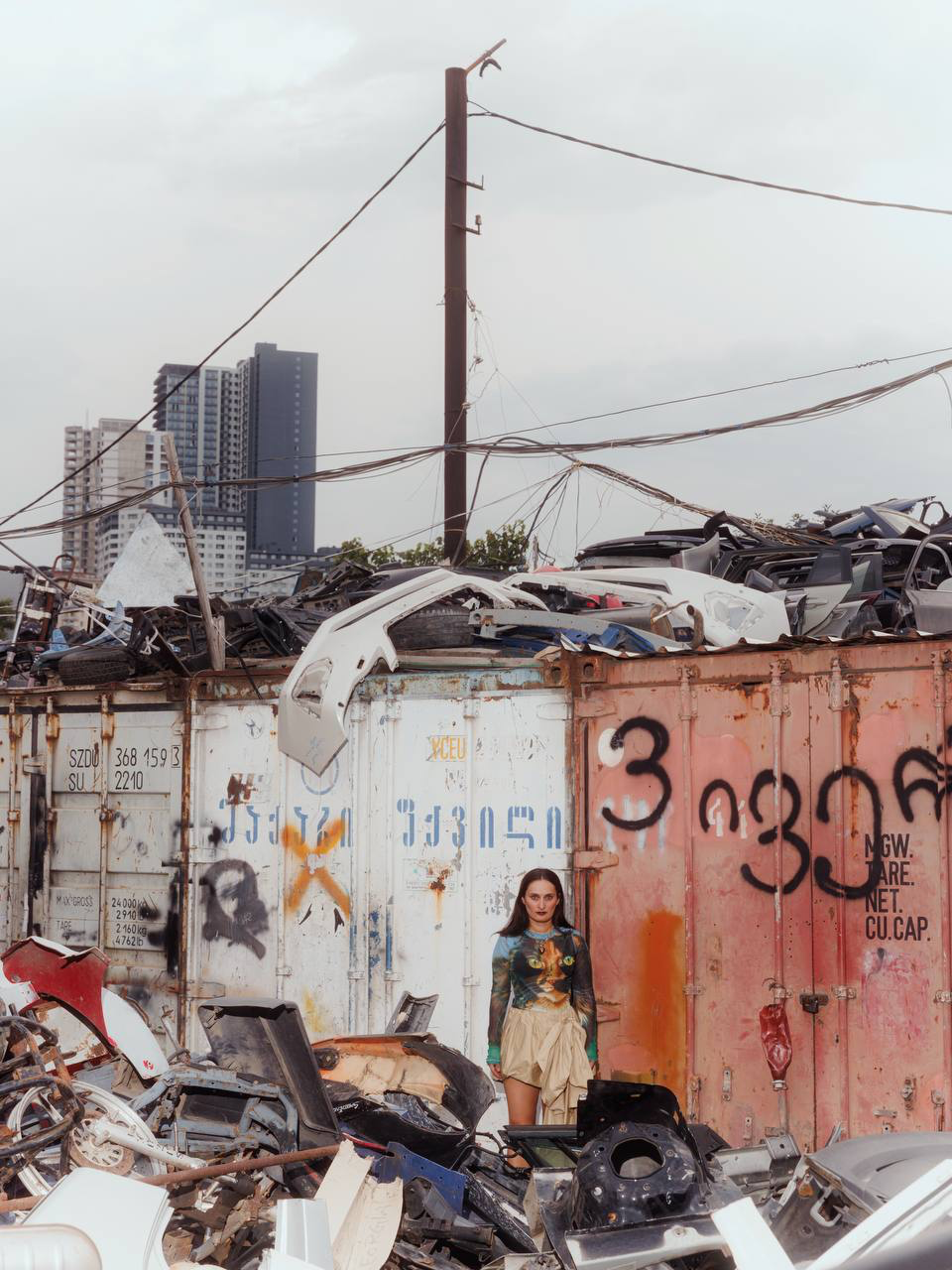
Fashion, as one of the most sensitive cultural registers of modernity, offers a privileged site through which to observe this transformation.
Contemporary Western societies are traversing a historical phase marked by a profound transformation of their symbolic foundations. Over recent decades, the recognition of colonial histories, racial hierarchies, and epistemic violence has fundamentally destabilized the moral and cultural legitimacy of the narratives through which Western modernity previously understood itself. Concepts such as progress, universalism, rationality, and development, once presented as neutral and emancipatory, have increasingly been exposed as historically situated and politically implicated, particularly within decolonial critiques of modernity and Western epistemology (Mignolo, 2011; Mbembe, 2017).
This recognition constitutes an essential ethical and intellectual achievement. At the same time, however, it generates a structural consequence that is rarely addressed: the erosion of shared symbolic coordinates through which collective identity is articulated. Western culture finds itself in a condition that may be described as post-recognition, in which dominant narratives have lost authority while alternative universal frameworks have not yet consolidated. The result is not merely political fragmentation, but a deeper instability at the level of meaning production.
Fashion, as one of the most sensitive cultural registers of modernity, offers a privileged site through which to observe this transformation.
To understand the nature of this crisis, Georg Simmel’s conception of fashion as a social form remains foundational. In Fashion, Simmel argues that fashion does not originate from aesthetic impulse but from the structural contradictions of social life. Fashion emerges from the simultaneous desire for social integration and individual differentiation. It functions as a mediating form through which individuals can appear as members of a collective while performing distinction within it (Simmel, 1957).
Fashion, in this sense, is not an object-based phenomenon but a relational one. It constitutes a technology of social coordination that regulates symbolic proximity and distance, inclusion and exclusion, conformity and deviation. Its significance lies not in particular styles but in its capacity to translate social tensions into visible form.
Central to Simmel’s analysis is the temporal dimension of fashion. Fashion expresses the rhythm of social life. Forms emerge, circulate, and disappear at a pace that corresponds to the tempo of social transformation. Different social groups relate to fashion not because of inherent aesthetic dispositions, but because of their position within uneven processes of social change. Fashion thus operates as an interface between differentiated temporalities within society (Simmel, 1957).
This insight resonates strongly with contemporary theories of social acceleration. Hartmut Rosa has described late modernity as a condition characterized by the continuous intensification of technological, social, and experiential change (Rosa, 2013). Acceleration, however, does not produce stability or coherence. On the contrary, it generates a permanent state of motion in which durable meaning becomes increasingly difficult to sustain.
Within this accelerated condition, fashion becomes structurally trapped. The multiplication of collections, drops, and micro-trends signals not an expansion of cultural vitality but a compensatory response to declining symbolic density. Simmel already anticipated this dynamic when he observed that the rapid disappearance of fashion forms reveals their internal emptiness. Speed becomes a substitute for substance (Simmel, 1957).
At the same time, contemporary fashion has undergone a structural shift from social form to content industry. Fashion increasingly operates as a system of image production optimized for platform circulation. Visual codes, aesthetics, and stylistic fragments circulate with minimal attachment to lived social contexts. Garments themselves no longer function as primary carriers of meaning; images do.
This transformation aligns with Guy Debord’s analysis of the society of the spectacle, in which social relations are mediated by representations, and with Jean Baudrillard’s account of simulation, where signs circulate independently of stable referents (Debord, 1994; Baudrillard, 1994). In such a regime, fashion ceases to translate social contradictions and instead recycles its own visual memory. Archives become aesthetic resources rather than sites of historical engagement. Quotation replaces articulation.
The classical mechanism described by Simmel — imitation followed by differentiation — also undergoes distortion. Platform capitalism privileges recognizability, repetition, and familiarity. Visibility is granted to what already resembles existing forms. Differentiation persists, but largely within narrow aesthetic parameters.
Pierre Bourdieu’s theory of distinction remains instructive here. Taste operates as a social classifier that naturalizes inequality by presenting it as personal preference (Bourdieu, 1984). In digital fashion culture, this classificatory function becomes obscured rather than eliminated. Distinction detaches from clearly legible class positions and attaches instead to lifestyle aesthetics and micro-identities. The result is a paradoxical configuration combining extreme segmentation with deep homogenization.
Simmel’s observation that both lower and higher social strata tend toward conservatism further illuminates the present condition. Lower strata often experience limited structural mobility, while higher strata seek to protect accumulated symbolic capital. In both cases, change itself becomes threatening, independently of its content (Simmel, 1957). This helps explain why contemporary fashion, despite its surface-level hyperactivity, exhibits a strong conservative core characterized by heritage fixation, archival dependence, and cyclical revival.
Mark Fisher’s concept of capitalist realism captures this impasse: a situation in which it becomes difficult to imagine alternatives to existing systems (Fisher, 2009). Fashion endlessly reinvents aesthetics while leaving its political economy and symbolic architecture largely untouched.
The contemporary crisis of fashion thus appears not primarily as a crisis of creativity, but as a crisis of mediation. Meaning emerges when symbols are anchored in shared social experience. Zygmunt Bauman’s account of liquid modernity describes identities as provisional, reversible, and permanently unfinished (Bauman, 2000). When instability becomes the dominant condition, fashion struggles to perform its historical function of translating social transformation into intelligible form.
Decolonial theory further complicates this landscape. Scholars such as Walter Mignolo and Achille Mbembe have emphasized that decolonization is not only a political or economic process but also an epistemic one. It entails the destabilization of dominant languages, categories, and classificatory systems (Mignolo, 2011; Mbembe, 2017). While this process is necessary, it also contributes to the fragmentation of shared semantic frameworks.
Language itself becomes contested terrain.
Fashion, which relies on symbolic legibility, is directly affected by this linguistic and epistemic destabilization. The weakening of shared categories undermines fashion’s capacity to articulate difference within a common horizon of meaning.
From this perspective, fashion’s contemporary exhaustion cannot be attributed to excessive change alone. The deeper issue is that fashion increasingly changes without social necessity. Forms circulate in the absence of clearly articulated collective tensions. Images multiply without performing symbolic work.
Simmel’s enduring relevance lies in his insistence that fashion is meaningful only insofar as it expresses social life. Fashion does not lead social transformation. It follows it and gives it form (Simmel, 1957). The crucial question, therefore, is not what the next trend will be, but what forms of social life are currently emerging and seeking articulation. Until fashion reconnects with this task, it will remain suspended in a state of perpetual motion without direction.
Baudrillard, J. (1994) Simulacra and Simulation. Translated by S.F. Glaser. Ann Arbor: University of Michigan Press.
Bauman, Z. (2000) Liquid Modernity. Cambridge: Polity Press.
Bourdieu, P. (1984) Distinction: A Social Critique of the Judgement of Taste. Translated by R. Nice. Cambridge, MA: Harvard University Press.
Debord, G. (1994) The Society of the Spectacle. Translated by D. Nicholson-Smith. New York: Zone Books.
Fisher, M. (2009) Capitalist Realism: Is There No Alternative? Winchester: Zero Books.
Mbembe, A. (2017) Critique of Black Reason. Translated by L. Dubois. Durham: Duke University Press.
Mignolo, W.D. (2011) The Darker Side of Western Modernity: Global Futures, Decolonial Options. Durham: Duke University Press.
Rosa, H. (2013) Social Acceleration: A New Theory of Modernity. Translated by J. Trejo-Mathys. New York: Columbia University Press.
Simmel, G. (1957) ‘Fashion’, American Journal of Sociology, 62(6), pp. 541–558.
%20(1).jpeg)